SintraCascaisSesimbra.com
The best independent guide to Sesimbra
SintraCascaisSesimbra.com
The best independent guide to Sesimbra
Sesimbra, Portugal: an independent holiday guide for 2026
By Philip Giddings · Last updated
Thirty minutes from Lisbon airport sits a beach town the Portuguese have quietly kept for themselves. No package tours, no high-rises, just a curve of golden sand, a working fishing harbour, and a street of family-run seafood restaurants tucked into the back alleys behind the seafront.
I was introduced to Sesimbra 26 years ago by my Portuguese cousin-in-law, who described it as the best beach town in Portugal. Two years ago I shared the secret with my brother, and this year he asked to go back with his young family. This is the magic of Sesimbra: it's discovered by word of mouth.
Sesimbra is a working fishing village: the boats go out before dawn, and by lunchtime the catch is on the table at one of the marisqueiras run by the same families for three generations. While the Atlantic pounds Costa da Caparica with surfing swells just up the coast, the Arrábida hills curve protectively around the bay, leaving the water calm enough for my six-year-old niece to paddle in. Above the whitewashed houses, a Moorish castle keeps watch from the hill, a reminder that this stretch of coast was once worth fighting for.
What I like most about Sesimbra is that it has resisted the slide into a generic beach resort. Tourism here is overwhelmingly Portuguese, and the town behaves accordingly. You'll hear Portuguese spoken in the cafés, eat at restaurants where the menu has barely changed in decades, and pay prices that tourism hasn't inflated.
Beyond the town, the wider region opens up in every direction: the windswept headland of Cabo Espichel and its dinosaur footprints, the turquoise coves of Portinho da Arrábida, the sandbar-sheltered Lagoa de Albufeira, and the wine estates of Azeitão. There's an adventurous side too, the only real change in 26 years, with sea kayaking into hidden caves, coasteering along the limestone cliffs, and paragliding above the Arrábida ridge.
My Portuguese wife's family has been holidaying in Sesimbra since she was a child, and over more than two decades we've brought every generation of our own family here, from my niece's first beach holiday to coasteering with my cousin. This guide passes on what we've learned across those years, so you can decide whether Sesimbra is right for your visit and make the most of it once you arrive.
My personal highlights of Sesimbra

Praia da Califórnia: The wide curve of sand that fronts the town, sheltered by the Arrábida hills and home to some of the calmest sea water on the Lisbon coast. There is nowhere better within an hour of the capital for a slow day on the beach with a young family.

Marisqueira restaurants: Family-run seafood restaurants tucked into the back alleys behind the main street, where the day's catch is cooked by the same families that have been running these kitchens for generations. My three favourites are O Rodinhas, Casa Mateus, and Marisqueira Modesto, and any of them will give you a meal you will remember.
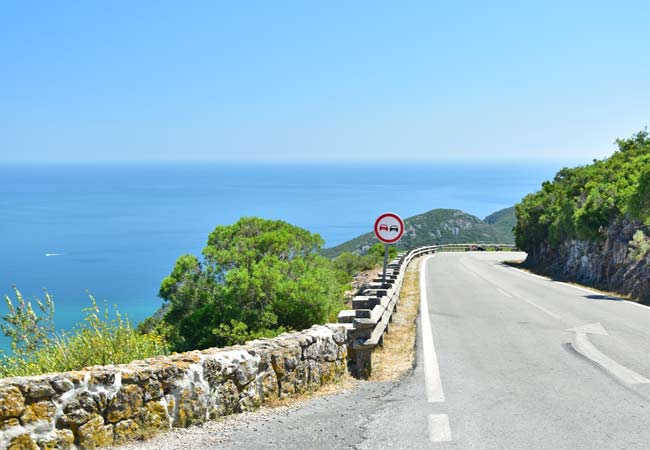
Serra da Arrábida: The hills that wrap around Sesimbra and hide some of the most beautiful coastline in Portugal. The N379 ridge road that runs along their spine is, in my opinion, the finest drive in the Lisbon region, and the beaches at its foot, such as Praia do Creiro and Praia dos Galapinhos, are reason enough to come.
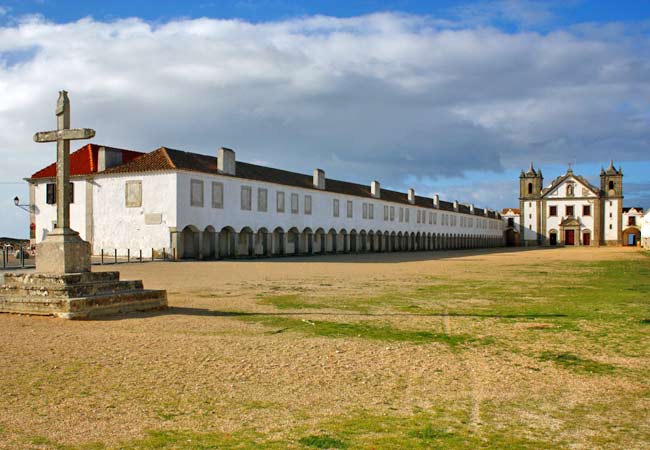
Cabo Espichel: The windswept headland at the southwestern tip of the peninsula, with colossal cliffs falling straight into the Atlantic. At its tip is a strange and atmospheric pilgrim church flanked by long lodging houses, and on the cliffs themselves are two sets of dinosaur footprints. It is one of the most haunting places in the Lisbon region, and at sunset it is unforgettable.

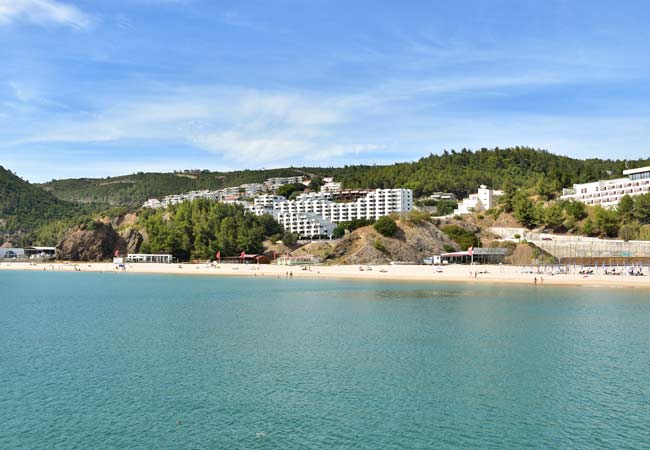
Kayaking: The Sesimbra coastline offers the best sea kayaking in the Lisbon region, with towering cliffs, hidden caves, and beaches you cannot reach any other way. The route from Sesimbra harbour around to Ribeira do Cavalo beach takes you past the Boca do Tamboril, a sea cave with a hole in its roof that lights the water below an extraordinary green.
Why have a holiday in Sesimbra?
Sesimbra is the rare beach town within easy reach of Lisbon that has not been reshaped for the foreign market. Tourism here is overwhelmingly domestic, and the experience that follows is the kind of holiday the Portuguese themselves want: long lunches over fresh seafood, late evenings in bars that fill up after ten, and prices that have not been inflated to match the international package crowd. If you are tired of beach resorts that feel interchangeable, Sesimbra is a useful corrective.
The town also works as a base for the wider region, which is one of the most varied corners of the country. Within an hour you can be tasting Moscatel at the wine estates of Azeitão, eating choco frito on the harbour at Setúbal, or driving the N379 ridge road across the Serra da Arrábida. The cliffs of Cabo Espichel and the lagoon at Lagoa de Albufeira are both easy half-day trips, and the beaches of the Portinho da Arrábida are some of the finest in Portugal. None of this is more than a short drive from the door of your hotel.
The location is the other quiet advantage. Lisbon airport is less than thirty minutes away by car, and central Lisbon is forty-five minutes by bus from the town itself, which means Sesimbra works as both a beach holiday in its own right and as an alternative base from which to see the capital without staying in it. Last year I brought my brother and his young family here for a week, partly because it gave them a calm beach for the children, and partly because they could still do a day trip into Lisbon when they wanted one. It is a combination very few beach towns within an hour of a European capital can offer.
Related articles: Sesimbra's beaches - Sights and activities
A note on timing: Sesimbra is quiet for most of the year, but during the Portuguese summer holidays in July and August, and over the long weekends in July and September, the town fills up and the better hotels and apartments sell out well in advance. If you are planning a trip in the high season, book as early as you can.
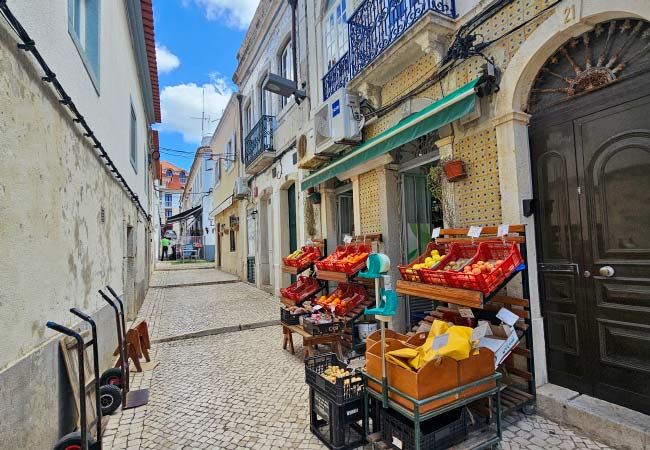
The pretty backstreets of Sesimbra
Sesimbra as a day trip from Lisbon
Whether Sesimbra works as a day trip from Lisbon depends almost entirely on whether you have a car. With one, the region opens up into one of the most varied day trips you can do from the capital. Without one, you are limited to the town itself, and there are honestly better options for a car-free beach day.
If you are travelling by public transport, I would steer you towards Cascais instead. Sesimbra by bus gives you the castle, the fishing harbour, the beachfront promenade, and a seafood lunch in one of the marisqueiras, which makes for a pleasant half-day but does not justify the hour bus ride each way. Cascais is closer, easier to reach by train, and offers a comparable beach-town experience with more to do once you arrive.
With a car, the calculation changes completely. You could comfortably combine Sesimbra with the cliffs of Cabo Espichel, the N379 drive across the Serra da Arrábida, and a wine tasting at Azeitão, all in a single day. An alternative I often suggest to friends is to split the day between Sesimbra and Setúbal, taking lunch in one and a long afternoon in the other. The region's best beaches, including Portinho da Arrábida, Lagoa de Albufeira, and the quieter southern stretches of Costa da Caparica, are also only really reachable by car. (Setúbal guide)
The two maps below set out my suggested route for a day trip to Sesimbra. The first is a close-up of Sesimbra town, with a walk linking the fort, the castle and the fishing harbour, while the second shows the wider region, with Sesimbra shaded, Cabo Espichel, the Serra da Arrábida and the beaches I would consider stopping at on the way, which are marked in yellow. (Note: click either map to see a full-size version)
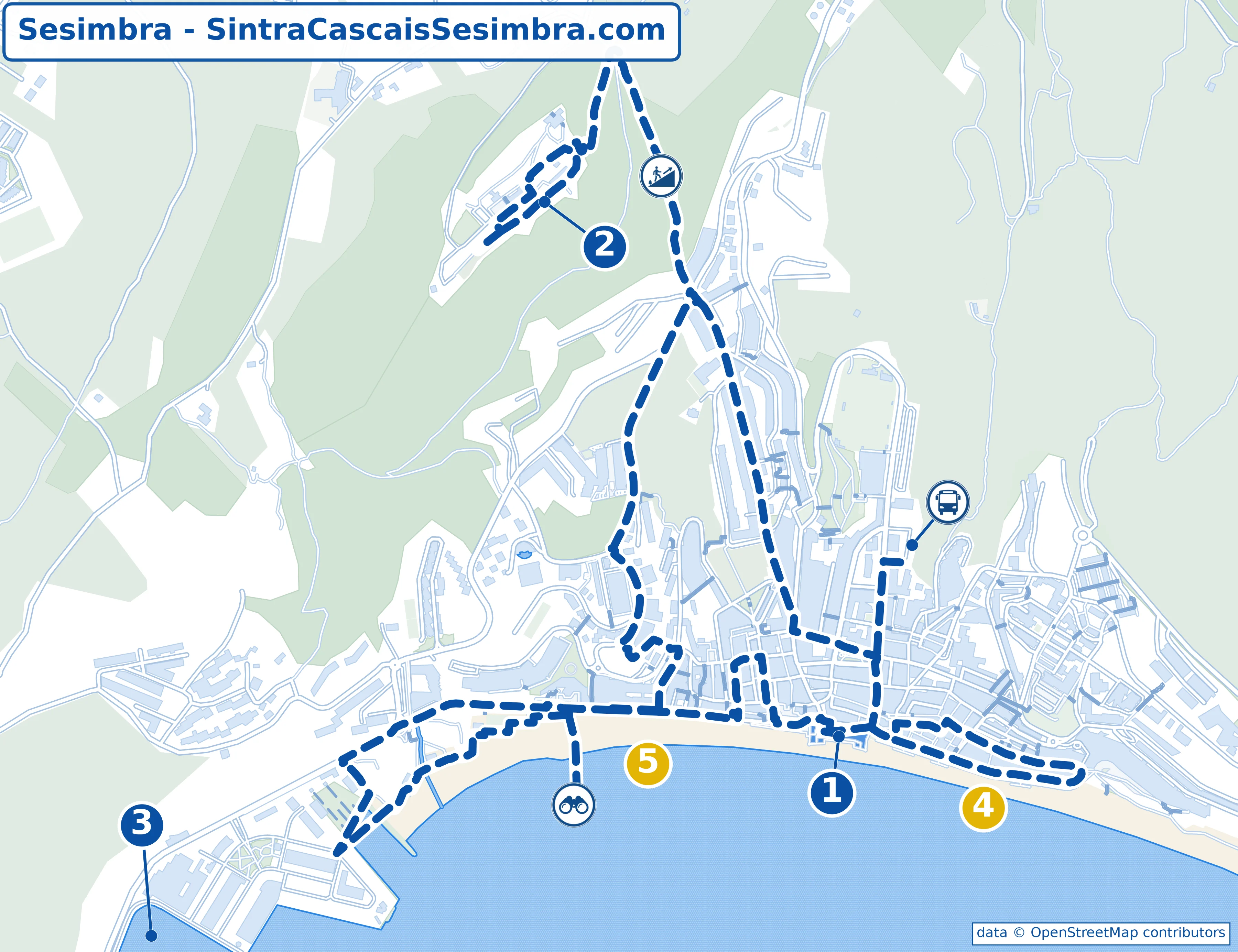
Sesimbra town: 1) Forte de Santiago 2) Castelo de Sesimbra 3) Cais dos Pescadores (fishing harbour)
Beaches: 4) Praia da Califórnia 5) Praia do Ouro
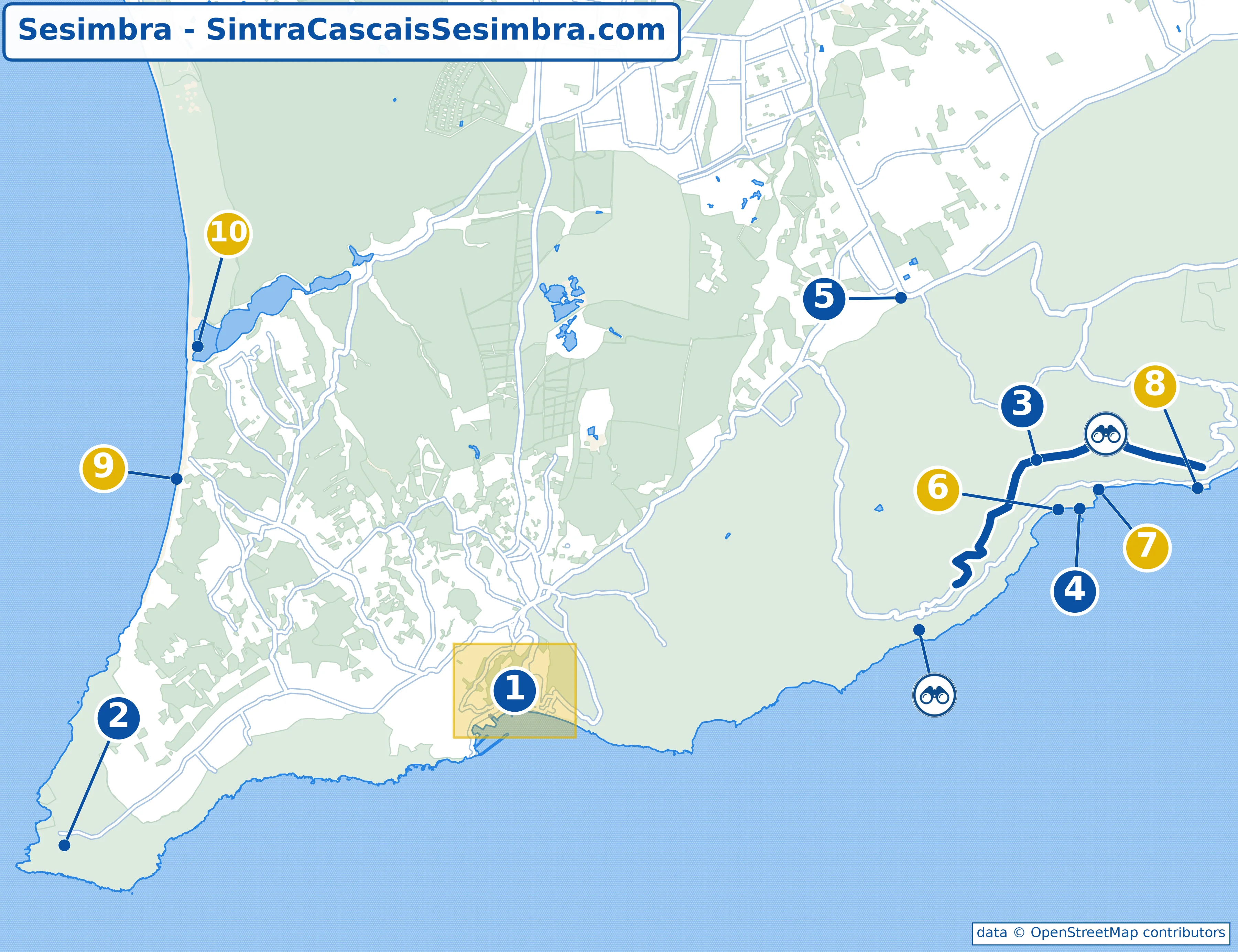
Sesimbra region: 1) Sesimbra (first map) 2) Cabo Espichel 3) Estrada de Escarpa (scenic drive) 4) Portinho da Arrábida 5) Azeitão (wine tasting at José Maria da Fonseca or Bacalhôa Vinhos)
Beaches: 6) Praia do Creiro 7) Praia de Galápos 8) Praia da Figueirinha 9) Praia do Meco 10) Lagoa de Albufeira
Related articles: Day trip to Sesimbra
Sesimbra as a base for adventure
The Arrábida hills that shelter the bay also produce the most dramatic stretch of coastline within easy reach of Lisbon, and over the past decade this has quietly turned Sesimbra into the adventure hub of the region. If you are the kind of traveller who likes a beach holiday with something more active built in, this is where I would send you.
Kayaking at Sesimbra
Kayaking is by far the most popular activity here, and worth knowing that almost every kayaking tour marketed as "Lisbon kayaking" is actually run out of Sesimbra, with a coach transfer down from the capital first thing in the morning. The wind and wave-sheltered coast west of the harbour is the best stretch of sea kayaking I have done in the Lisbon region, with caves to paddle into and beaches you cannot reach any other way. Most trips leave from the harbour, round the sea wall, and head west to Ribeira do Cavalo beach, with longer routes continuing as far as Praia da Mijona.
The highlight of the route is the Boca do Tamboril, a sea cave with a hole in its roof that lights the water below an extraordinary green. Along the way you will also pass the Pedra do Leão, a rock formation said, with some imagination, to resemble a lion, and the Caverna do Frade, the largest cave on this stretch of coast.
You can either join a guided tour or rent a kayak and go independently. I have done both, and each has its trade-offs. The guided tour gives you a local guide and the safety net that comes with one, but the pace is set by the slowest paddler in the group and you tend to feel rushed at each stop. Going independently is more flexible and lets you take your time, but you will need to take any local advice on conditions seriously before setting off.
Pulling our kayaks onot the Ribeira do Cavalo beach
***Coasteering the limestone cliffs
The other popular activity along the Sesimbra coast is coasteering, which involves scrambling along the cliff edges, jumping into the sea from heights of up to eight metres, and swimming between the rocky outcrops in between. I have done it twice and it is enormous fun, but it is also one of the most physically draining things I have done in Portugal.
Only book this if you are fit, comfortable with heights, a confident swimmer, and have plenty of energy in reserve. One piece of practical advice: try to book onto a session with the smallest group size you can find. In larger groups there is a lot of waiting around at each jump while everyone takes their turn, which kills the pace and the warmth on a cold day. Both of my coasteering sessions were with Vertente Natural.
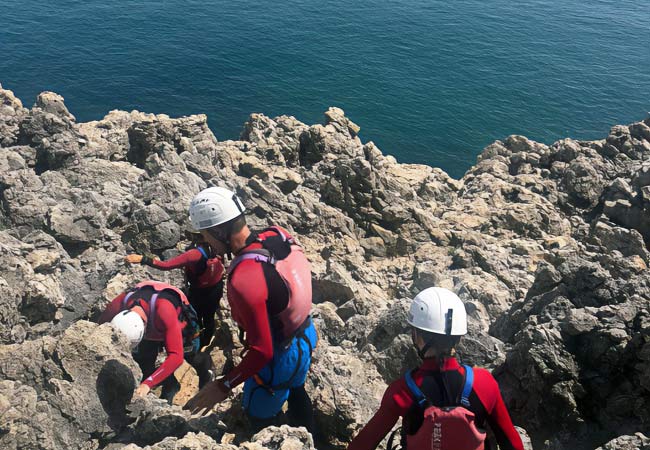
Scrambling over the sharp limestone cliffs down to the first 5-metre jump into the freezing water.
Diving in the Arrábida marine reserve
The waters off Sesimbra fall within the Arrábida marine reserve, which has some of the clearest water on the Portuguese coast and a healthy population of fish that benefits from the protection. There are several wreck dives along this stretch as well, the best known of which is the River Gurara, a Nigerian cargo ship that ran aground in 1989 and now lies on the sea bed at around thirty metres. Sesimbra has a number of dive schools running both shore dives and boat dives, and the season runs from late spring through to early autumn when the visibility is at its best.
Hiking and cycling in the Arrábida
The Serra da Arrábida is also crossed by a network of hiking and cycling trails, most of which are managed within the natural park. Hikers tend to head for the Serra do Risco trail, which runs along the top of the highest sea cliffs in mainland Portugal and gives you views straight down into the marine reserve below. Cyclists have a harder ride: the hills are steep and the climbs are unrelenting, but the descents and the ridge views are the reward, and the N379 ridge road is one of the great cycling routes in the region. For either activity, the cooler months from October to May are far more pleasant than the height of summer.
Paragliding
Paragliding runs either over the southern end of the Costa da Caparica from Praia das Bicas, or over the Serra da Arrábida hills and coast, depending on wind direction on the day. I have not done this myself, but I have watched paragliders skim the cliffs above Sesimbra on enough occasions to know it is a serious view from the air. If you are comfortable with heights and the conditions are right, it is one of the more memorable ways to see the coastline.
Are there good beaches in Sesimbra?
Sesimbra sits at the centre of one of the best stretches of beach coast in Portugal, with three distinct types of beach all within a thirty-minute drive. Which of them suits you depends on what you want from a day on the sand.
The town beach itself is the calmest, and the easiest to recommend if you have young children or simply want a relaxed day without a long drive. The wide sandy bay in front of Sesimbra splits into two: Praia da Califórnia to the east, and Praia do Ouro to the west, between the fishing harbour and the foot of the castle. The Arrábida hills wrap around the bay closely enough to block both the Atlantic swell and the prevailing winds, and on days when the rest of the Lisbon coast is blustery and rough, Sesimbra will often be calm and warm. This single quirk of geography is the reason Portuguese families have been holidaying here for generations.

The Praia do Ouro beach on a quiet Tuesday in May; during the summer it will be much busier
A short drive east of the town, the coastline of the Portinho da Arrábida is something else entirely. Here the Arrábida hills meet the sea directly, and the small cove beaches at their feet, including Praia do Creiro, Praia de Galápos, and Praia da Figueirinha, have water clear enough for snorkelling and a backdrop of forested limestone cliffs that genuinely justifies the trip.
The catch is that these beaches are tiny and famous, and parking is the central problem of any visit. On my last August trip I watched the local police work along the access road handing out fines to anyone who had given up and parked on the verge. If you want one of these beaches in summer, plan to arrive before ten in the morning.
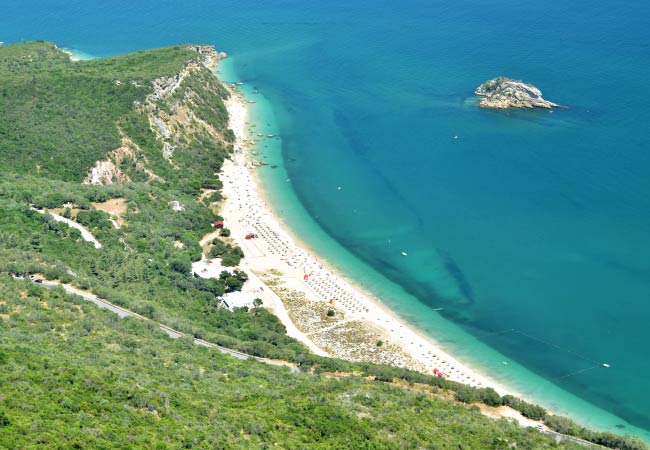
The Praia do Creiro is a stunning beach
To the northwest, the Costa da Caparica coastline opens up into a thirteen-kilometre stretch of Atlantic-facing sand, with surf, wind, and space in equal measure. These are the beaches to head for if you want waves and a long walk, but they are also exposed, so check the wind forecast before committing to a day there.
My pick along this coast is the Lagoa de Albufeira, which sits roughly halfway between Sesimbra and Costa da Caparica proper. A vast natural lagoon is separated from the Atlantic by a sandbar wide enough to walk along, and its waters are calm and shallow, making it excellent for paddleboarding and a safe option for younger children when the sea side is too rough.
Related articles: Lagoa de Albufeira - Sesimbra beach guide
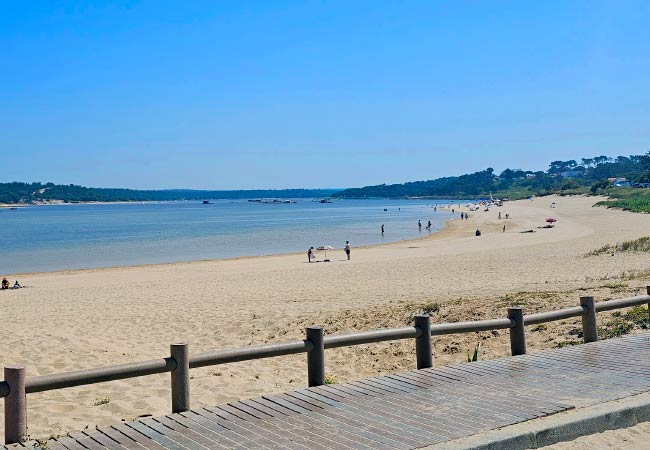
The Lagoa de Albufeira
Sesimbra’s seafood
Sesimbra eats well because Sesimbra fishes well. The boats moor up on the western side of the bay through the morning, the catch is auctioned at the harbour, and by lunchtime it is on plates in the marisqueiras tucked into the back streets behind the seafront.
The dish to order, at least once, is Arroz de Marisco. A deep clay pot arrives at the table full of soupy short-grain rice, crab, prawns, clams, and whatever shellfish the kitchen has working that day, and you eat it slowly, sharing between two or three. It is unhurried food, designed for a long lunch with a cold bottle of vinho verde. The other Sesimbra speciality, and the one I would point you towards if you have not eaten it before, is grilled espadarte. You will see it on almost every menu in town, simply grilled with potatoes and a green salad, and there is no better place in Portugal to try it.
The best of the marisqueiras are tucked away on Rua Joaquim Brandão and Rua Marques de Pombal, two streets behind the main seafront that fill with the smell of grilling fish from late afternoon onwards. My three favourites are Marisqueira Modesto, O Rodinhas, and Casa Mateus. If you would rather eat looking out over the sea, O Velho e o Mar on the seafront promenade is the most reliable choice, with grilled fish at the centre of the menu and a view that does not need explaining.
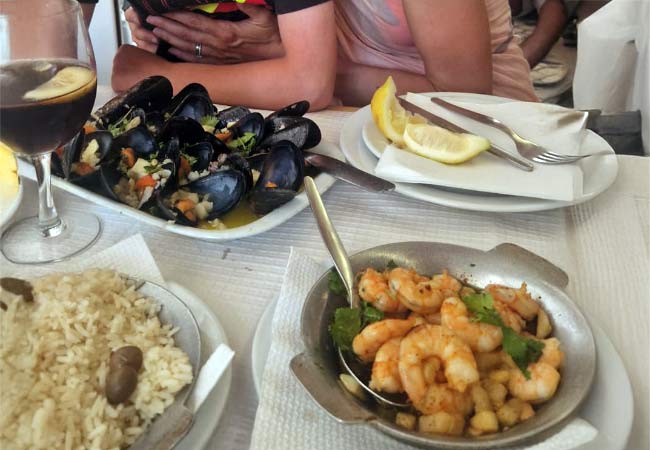
Our delicious meal at O Rodinhas. These were some of the first mussels my nephew ever tried, and they were honestly some of the finest I have ever eaten
The Cabo Espichel
Cabo Espichel is the headland at the southwestern tip of the Setúbal Peninsula, fifteen minutes by car west of Sesimbra, and one of the most atmospheric places I know in the Lisbon region. Vast cliffs drop straight into the Atlantic, a working lighthouse stands at their edge, and behind it sits a strange, half-abandoned pilgrim church flanked by two long ranks of eighteenth-century lodging houses where the faithful once stayed during the annual pilgrimage.
Pressed into the exposed cliff face below the headland are two sets of dinosaur footprints, left in the rock when this stretch of coast was a tidal mudflat one hundred and forty million years ago.
Related articles: The Cabo Espichel
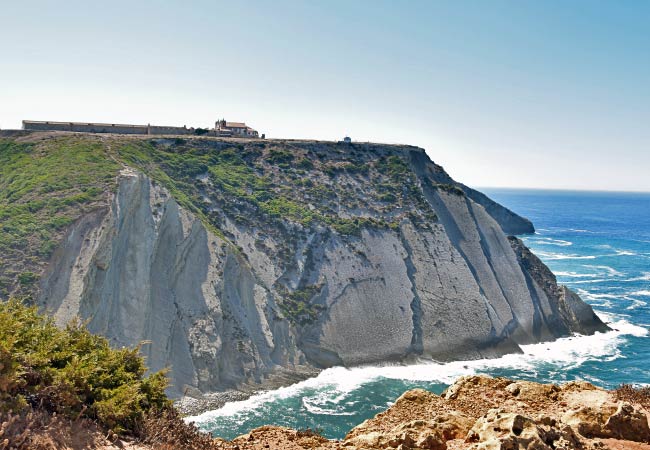
The massive cliffs at the Cabo Espichel
The Parque Natural da Arrábida
The Parque Natural da Arrábida protects the limestone hills that run between Sesimbra and Setúbal, and the marine reserve in the waters at their feet. The southern side of the range is the dramatic one, with cliffs falling into the small cove beaches of the Portinho da Arrábida, while the gentler northern slopes around Azeitão are planted with the Muscat vines that produce the region's celebrated Moscatel wines.
Cutting through the heart of the park is the N379 ridge road, locally known as the Estrada de Escarpa, which climbs up from the coast, runs along the spine of the hills, and gives you views down over the marine reserve and across to the Tróia Peninsula on the way. It is, in my opinion, the finest drive in the Lisbon region, and reason enough on its own to hire a car for a day.
Related articles: The Serra da Arrábida

Castelo de Sesimbra
The Castelo de Sesimbra stands on the hill directly above the town, a Moorish stronghold built in the ninth century, taken by the Christian forces of Afonso Henriques in 1165, and rebuilt in stone by King Sancho II in the thirteenth. It is larger than it looks from below, with a full circuit of battlements that gives you the best view in town: the bay, the harbour, the Arrábida hills, and the Atlantic stretching south to Cabo Espichel. The walk up from the town centre takes around twenty minutes and is steep enough that I would not attempt it in the middle of an August afternoon.
Related articles: Castelo de Sesimbra
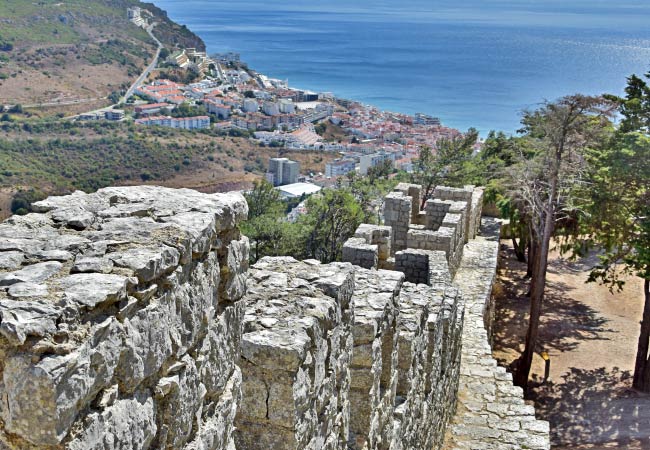
It’s a steep walk up to the castle but the views are worth it
Travel to Sesimbra
A car is the best way to explore the wider region, but for a day trip into Sesimbra itself the bus from Lisbon works perfectly well. The 3721 route, run by Carris Metropolitana (carrismetropolitana.pt) leaves from Sete Rios bus station in Lisbon and takes around seventy minutes to reach Sesimbra, with a single fare costing €4.65.
Related articles: Lisbon and the airport to Sesimbra

When to visit Sesimbra
Sesimbra is a year-round town, but the version of it you experience depends entirely on when you arrive. June and September are, in my opinion, the best months to visit. The weather is reliably warm, the sea is swimmable, and the town is busy enough to feel lively without being overwhelmed. If you are coming for the beach but would rather avoid the crowds, these are the two months to aim for.
July and especially August are a different proposition. The Portuguese take their summer holidays in August, and Sesimbra is one of their favourite spots, which means the town fills up, the beaches at Portinho da Arrábida become near-impossible to park at, and hotels and apartments need to be booked well in advance. It is also the most vibrant time to be here, with packed marisqueiras every evening and the bay alive with boats and bathers. If you want Sesimbra at its loudest and warmest, August is when to come, but plan ahead.
May and October sit either side of the beach season. The weather is generally pleasant, the town is calmer, and prices are lower, but the sea will be on the cool side for swimming. Outside of these months, Sesimbra is quiet, with mild winters that can be a fine time for hiking the Arrábida or driving the N379, even if the beach itself is off the table.
Our most popular guides to the Sesimbra region


Author bio: I'm Philip Giddings. I live in Graça with my Portuguese wife Carla, whose family are Lisboetas going back generations. I've been visiting Portugal since 2001, writing the independent guides at SintraCascaisSesimbra.com since 2012, and the site is now my full-time work. Carla's cousin first brought me to Sesimbra on an early trip, and twenty-five years on we are still heading to the same beaches
This site has 30 guides on Sesimbra, Setúbal and Estoril. It takes no payment from tourist boards, tour operators, or attractions for inclusion, and is funded by affiliate commissions on tour bookings, disclosed on every page that contains them. Every practical detail (ticket prices, opening hours, bus routes, time-slot policies) is checked against the official sources and verified in person on the walks I make through the town each week. Read my full bio here.